

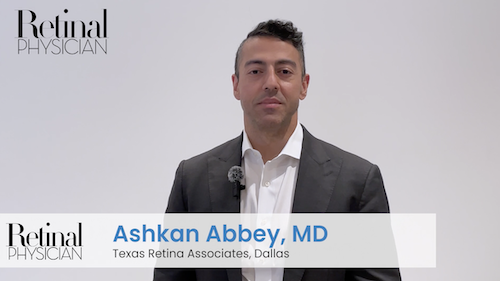
Texas Retina’s Ashkan Abbey, MD, presented baseline characteristics of participants in the Phase 3 ARCHER II clinical trial for geographic atrophy (GA) secondary to dry age-related macular degeneration (AMD) at the 59th Annual Scientific Meeting of The Retina Society held September 23-26, 2026, in Los Angeles, California. He spoke on behalf of the ARCHER and ARCHER II investigators.
Founded in 1968, The Retina Society is dedicated exclusively to educational and scientific efforts related to the diagnosis, care and treatment of retinal diseases and injuries. Dr. Abbey was inducted into the organization in September 2024.
The ARCHER II Study
ARCHER II is an ongoing, global, randomized, double-masked Phase 3 clinical trial evaluating vonaprument (formerly known as ANX007), an investigational treatment for GA secondary to dry AMD.
Vonaprument is a localized inhibitor administered by intravitreal injection. It targets C1q, a key trigger molecule in the classical complement and neuroinflammatory pathways associated with photoreceptor degeneration.
The Phase 3 trial has enrolled 659 patients globally, including 12 at Texas Retina. Its primary endpoint is the prevention of a loss of 15 or more letters in best-corrected visual acuity (BCVA) – equivalent to approximately three lines on a standard eye chart — measured through Months 15 and 24.
During his presentation, Dr. Abbey also shared key findings from the previous Phase 2 ARCHER trial, including:
- The study demonstrated dose-dependent vision protection across key measures of visual acuity and patient populations.
- At 12 months, confirmed loss of 15 or more BCVA letters occurred in 4.5% of patients receiving monthly treatment and 8.7% of those receiving treatment every other month, compared with 16.9% of patients in the sham-control group.
- A greater effect was observed among patients with healthier eyes. Among them, no patients in the monthly treatment group experienced confirmed loss of 15 or more BCVA letters at 12 months, compared with 4.1% in the every-other-month group and 11.9% in the sham-control group.
- Protection against vision loss protection was also stronger among patients with non-foveal lesions than among those with foveal lesions.
Dr. Abbey went on to discuss how the ARCHER II trial design is consistent with the ARCHER study demographics and baseline characteristics of the ARCHER study. He also highlighted how the ARCHER II population reflects the patient characteristics associated with larger treatment effects seen in the Phase 2 ARCHER study.
“What makes the ARCHER trials exciting is that vonaprument is being evaluated with the potential to directly preserve and protect vision, rather than simply slowing the growth of lesions,” says Dr. Abbey. “This could be a significant step forward in our treatment approach to GA secondary to dry AMD, and we look forward to learning more through the Phase 3 study.”
Dr. Abbey recaps his presentation to The Retina Society in this video.
See all the clinical trials currently available at Texas Retina.
About Dr. Abbey
Dr. Abbey serves as Texas Retina’s Director of Clinical Research for Dallas and cares for patients at the Dallas Main and Rockwall offices.