

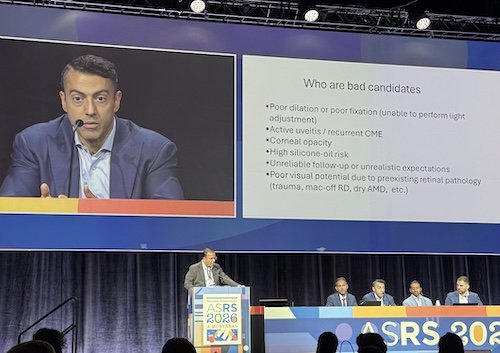
Texas Retina’s Ashkan Abbey, MD, FASRS, FAAO, participated in a panel discussion on the impact of vitrectomy on light adjustable lenses before final laser lock-in in post-cataract surgery patients at the 44th American Society of Retina Specialists (ASRS) Annual Scientific Meeting held in Montréal, Canada, July 15-18, 2026.
The session began with a presentation by Osama Sabbagh, MD, of The Retina Group of Washington, followed by the panel discussion with moderator Gaurav Shah, MD, of The Retina Institute in San Francisco and additional panelists Murtaza Adam, MD, of Colorado Retina Associates and Ankoor Shah, MD, FASRS, from Retina Consultants of Texas in Houston.
What is a Light Adjustable Lens?
The Light Adjustable Lens (LAL) is a special type of intraocular lens (IOL) used during cataract surgery that can be customized and fine-tuned after the surgery. Unlike standard IOLs, where the power is fixed once implanted, an LAL can be modified using ultraviolet (UV) light treatments while it is inside the eye.
How Does an LAL Procedure Work?
First, the cloudy natural lens is removed, and the LAL is implanted. This is followed by a healing period. Once the patient’s vision stabilizes, vision testing is performed. If needed, the surgeon can shine a specialized, controlled UV light onto the lens that changes the lens’ shape slightly, adjusting its focusing power. When the patient is satisfied with their vision, one or two final light treatments permanently “lock in” the lens so it no longer changes.
What Role Does Vitrectomy Play in LAL?
Performed by a retinal surgeon, vitrectomy is a surgical procedure that carefully removes the vitreous gel that fills the posterior segment of the eye. This surgery can correct several different eye problems, including a retinal detachment, epiretinal membrane, or macular hole.
A vitrectomy performed after cataract surgery but before final LAL laser lock-in can have important implications because the LAL’s refractive power is still intentionally adjustable during this period.
Insight About LALs Shared by Dr. Abbey
During the panel discussion, Dr. Abbey discussed:
- Why the LAL is a different explant
- The challenges of performing surgery on an eye with an LAL
- When to consider scleral fixation of an LAL
- The importance of careful patient selection, including considerations and cautions
“The refractive problem in secondary IOL surgery is not just lens power, it is final lens position,” explained Dr. Abbey. “That is why the ideal candidate for vitrectomy on an LAL before final laser lock-in has a complex anatomy but a vision goal worth chasing.”
He concluded by sharing the following four clinical pearls for retina surgeons:
- Aim for a good result before adjustment. Use LAL adjustability to refine a well-centered, stable lens — not to rescue poor fixation.
- Treat haptics gently. The PMMA haptics and haptic–optic junctions are the highest-risk material interface. PMMA haptics are the small, rigid, stabilizing loops attached to the central part of an IOL.
- Don’t rush the light treatment. Delay until the cornea, retina, IOL position, and refraction are stable.
- Keep a backup lens ready. The best premium case is the one where you can safely pivot when the anatomy or haptics say “no.”
Additional ASRS 2026 Paper Presentation
In addition to his participation in the LAL panel discussion, Dr. Abbey also presented a paper at ASRS 2026 on the results of the COED study. A prospective, randomized, comparative trial conducted exclusively at Texas Retina, COED compared two treatment regimens for diabetic macular edema (DME): a combination of an intravitreal dexamethasone implant (Ozurdex) and aflibercept (Eylea) versus aflibercept alone. The results were published in the medical journal Retina earlier this year.
About Dr. Abbey
Dr. Abbey serves as Texas Retina’s Director of Clinical Research for Dallas and cares for patients in our Dallas Main and Rockwall offices. In 2024, he earned a Senior Honor Award from ASRS in recognition of his time and contributions to the scientific programs of their annual meetings.
Click HERE to learn more about Dr. Abbey.