

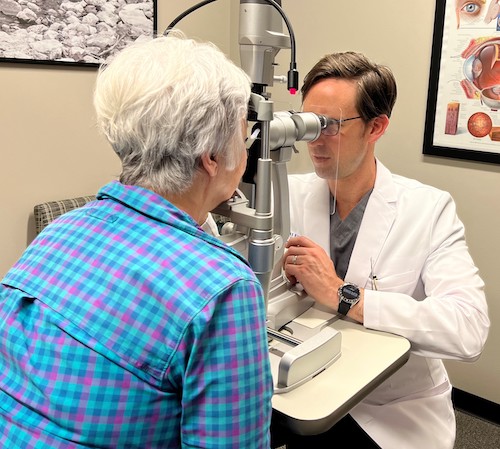
Retina exams are typically more involved than a routine eye exam. At Texas Retina, we make every effort to evaluate, test, diagnose and treat you all on the same day. As a result, an initial comprehensive evaluation, with or without treatment, could last anywhere from two to four hours. So, what can you expect from your retina exam?
Examining Your Eyes
We encourage you to come prepared to discuss your complete medical and family history as well as any symptoms you’re experiencing. Our medical team will perform a vision test and a measurement of your intraocular pressure, followed by dilation of your eyes. After a wait to allow your pupils to dilate adequately so we can see all the way into the back of your eye where your retina, macula and optic nerve are located, your Texas Retina physician will perform a comprehensive exam.
Specialized Diagnostic Testing Available in Our Offices
Depending on your specific condition, you may undergo additional diagnostic testing, which can include:
- Optical Coherence Tomography (OCT) – a non-invasive, non-contact device that obtains an extremely high-resolution, cross-sectional image of the affected area, and enhances diagnosis and treatment of patients with macular degeneration, macular holes, diabetic macular edema and other macular diseases. Click HERE to learn more about OCT testing.
- Fluorescein Angiography – involves the injection of a small amount of vegetable-based dye through a peripheral vein — usually in the arm or hand. Shortly after, a certified ophthalmic angiographer takes a series of time-dependent retinal photographs. The injected dye lights up your retina’s intricate vascular network and helps pinpoint problem areas. Click HERE to learn more about what to expect from a fluorescein angiography test.
- Diagnostic Ultrasound – uses sound waves to form an image of the eye and is used to examine the inside of your eye.
- Fundus Photography – a non-invasive diagnostic procedure that provides photographs of the back of the eye to help determine the health of your optic nerve, vitreous, macula, retina and its blood vessels.
- Visual Field Testing – a non-invasive, computerized, diagnostic procedure that monitors your peripheral vision and provides information about the neurological function of your retina, optic nerve and brain.
We provide a full range of diagnostic testing at all our Texas Retina offices, using the latest technology and equipment.
Your Treatment Plan
Based on the findings of your exam and testing, your Texas Retina physician will work with you to develop a customized treatment plan for your specific condition. Some types of treatment, like intravitreal injections and laser procedures, can be performed in our office at the time of your visit as long as your insurance will allow it. If your condition requires surgery, it will be scheduled at a future date and will take place in a local outpatient surgery center or hospital.
Finally, we encourage you to bring a pair of sunglasses and someone to drive you home since your eyes will remain dilated for several hours after your exam.
Click HERE to access our video gallery and learn more about what to expect from your care at Texas Retina.